
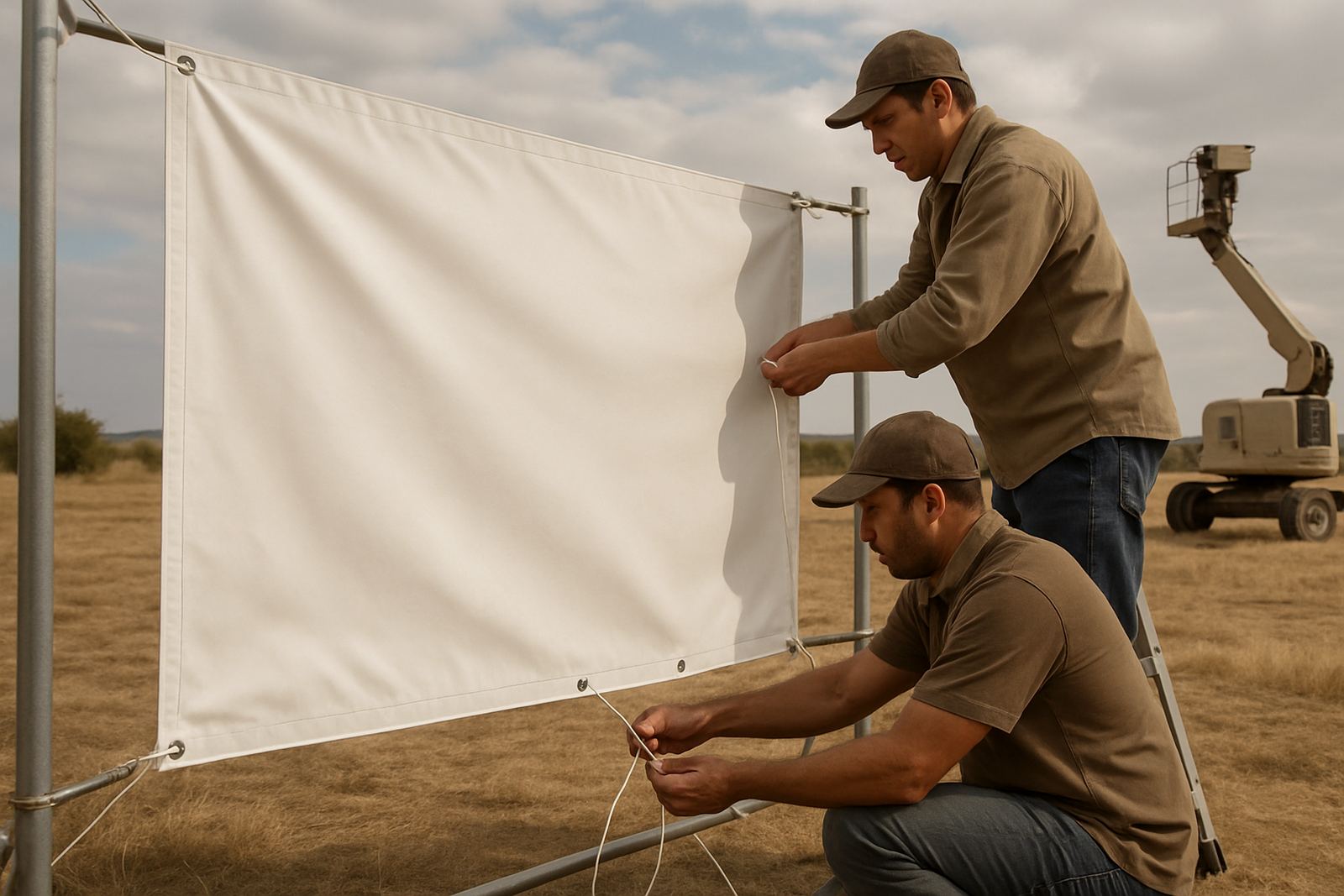
Why Free State weather is harder on banners than people think
In Bloemfontein, a banner does not just sit there and look neat. It has to cope with dry heat, sudden gusts, afternoon storms and long hours of strong sun. A banner that looks fine on installation day can start curling, fading or tearing if the site conditions were not checked properly first.
Wind is the big one. Even a medium sized banner acts like a sail when it is mounted across an open fence line or on a stand-off frame. If the tension is too high, the eyelets and hem take the strain. If the tension is too low, the material whips about and the edges wear out fast. That is why site surveys matter before printing and fitting. You need to know what the banner will face, not just where it will hang.
Sun is the other constant. UV exposure breaks down ink and weakens some banner materials over time. On north and west facing walls the fading shows faster. Add dust, and the banner can start looking tired long before the message has run its course.
Choosing the right banner weight and finish for the job
Not every banner should be treated the same. A short term sale banner for a shopfront in Mangaung is different from a roadside promotion on the route to Botshabelo or a long term fence banner at a warehouse yard in Hamilton. The material thickness, hem detail and fixings should match the use period and the exposure.
For short campaigns, a lighter banner can work well if it is placed in a sheltered spot. For longer runs, a heavier grade is usually better because it holds its shape and copes better with tension. Where wind passes through or around the banner regularly, reinforced edges help reduce tearing at the eyelets. A clean printed finish also matters because a banner with poor lamination or weak ink coverage will show wear quicker, especially near loading bays and dusty roads.
- Use heavier material for exposed sites and long term display periods
- Ask for reinforced hems and properly spaced eyelets
- Match the banner size to the fixing points, not just the wall space
- Allow for extra stress where corners catch the wind first
Tension, fixing points and why corners fail first
Most banner damage starts at the corners. That is where the tension is concentrated and where poor fixing usually shows up first. If a banner is pulled unevenly, one side takes more strain than the other and the material starts to stretch or tear. When that happens, the banner can look crooked too, which is never a good look for a business sign.
Good installation is about balance. The fixing points need to be set evenly and the banner should be tensioned in a way that keeps it flat without over stretching it. On wall mounted banners this may mean using the correct eyelet spacing and making sure the anchors are set into sound material. On fence banners, it may mean allowing a little movement rather than trying to pull the banner drum tight.
Where a banner is exposed to repeated gusts, maintenance visits are worth doing. A quick check can catch loose ties, tired eyelets or a corner that has started to fray before the whole banner fails. Small fixes now save replacement costs later, and that matters when you have multiple sites to keep up.
Sun fade, moisture and the difference between inland and coastal use
Bloemfontein is drier than the coast, but that does not mean banners get an easy ride. Inland heat and dust can still age print fast, especially on facades that get full sun all day. In towns like Welkom and Kroonstad, wind and open site exposure can be just as rough as the heat. Further east and north, weather changes can be more unpredictable, so the fitting needs to take that into account.
Coastal humidity is a different story, but many businesses still ask for advice when banners are used in places with high moisture or salty air. In those conditions, fixings and frames need more attention because corrosion can weaken the setup. Even inland, a banner near irrigation, wash bays or shaded walls can collect moisture at night and dry out by midday, which puts added stress on the fabric and the print.
A banner should be chosen for the site, not just the artwork. If the message is only needed for a month, a simpler setup may do the job. If it has to stay up for longer, the print and fixing need to be planned properly from the start.
A local example from a windy Bloemfontein frontage
Take a shopfront facing a broad street in central Bloemfontein. The owner wants a banner for a promotion running through payday week. The frontage catches wind in the afternoon and the wall gets hard sunlight most of the day. If the banner is made too light, it may ripple and crease before the weekend. If it is over tightened, the eyelets can start pulling through by day three.
In that setting, the better answer is usually a properly sized banner with reinforced edges, a sensible fixing pattern and print that is clear from a passing car. The same approach works for business parks in Mangaung or roadside promotion near Botshabelo where vehicles pass fast and the message has to be read in seconds. The banner does not need to shout, it just needs to stay put and stay legible.
This is also where a clean artwork setup helps. Small text disappears fast on a moving street, and poor contrast gets lost in glare. A banner that performs well outdoors is usually simple, well spaced and built around how people actually see it.
When to repair, replace or remove a banner
Not every worn banner needs to be thrown away immediately. Some can be repaired if the damage is limited to an eyelet or a small tear near the edge. But once the print is badly faded, the hem has split, or the banner has started stretching out of shape, replacement is usually the sensible call. A tired banner can make a business look neglected, even if the rest of the site is tidy.
Removal matters too. If a banner is only for a seasonal campaign, leaving it up after the message has passed can make a site look cluttered. In windy months, old banners can become a hazard as well. It is better to take them down on time than to wait for a storm to do it for you.
- Repair small tears early before they travel along the hem
- Replace banners once fading makes the message hard to read
- Remove seasonal banners before they become weather damaged
- Book maintenance visits for sites that face regular wind or sun
Better banner performance starts before the first print run
A banner is only as good as the planning behind it. The right material, the right size, the right fixings and the right installation all work together. When those pieces are sorted properly, the banner lasts longer, stays cleaner and keeps doing its job through sun, wind and load shedding related delays without looking tired after the first spell of bad weather.
For businesses across Bloemfontein, Mangaung, Botshabelo, Thaba Nchu, Welkom and Kroonstad, weather proofing is not a luxury. It is part of making signage that works outside the office, outside the shop and outside in the real world. That is the difference between a banner that flaps around and one that carries the message properly.
If the site is exposed, it is worth asking for advice before the banner goes to print. A few practical choices at the start can save a lot of trouble later, and that is usually the cheapest way to do it.
Small details that make a big difference outdoors
On paper, banners look simple. In practice, they need a fair bit of thought to perform well outside. A clean layout, a proper edge finish and correct tension all help the banner handle the weather better. In our work, the difference between a banner that lasts and one that fails is often one or two small decisions made early, not a dramatic change at the end.
That is why we always look at the site first when possible. A banner beside a sheltered entrance, a fence line on open ground, or a wall facing the afternoon sun all need a slightly different approach. When you get those details right, the banner stays readable, presentable and useful for the full campaign period.