

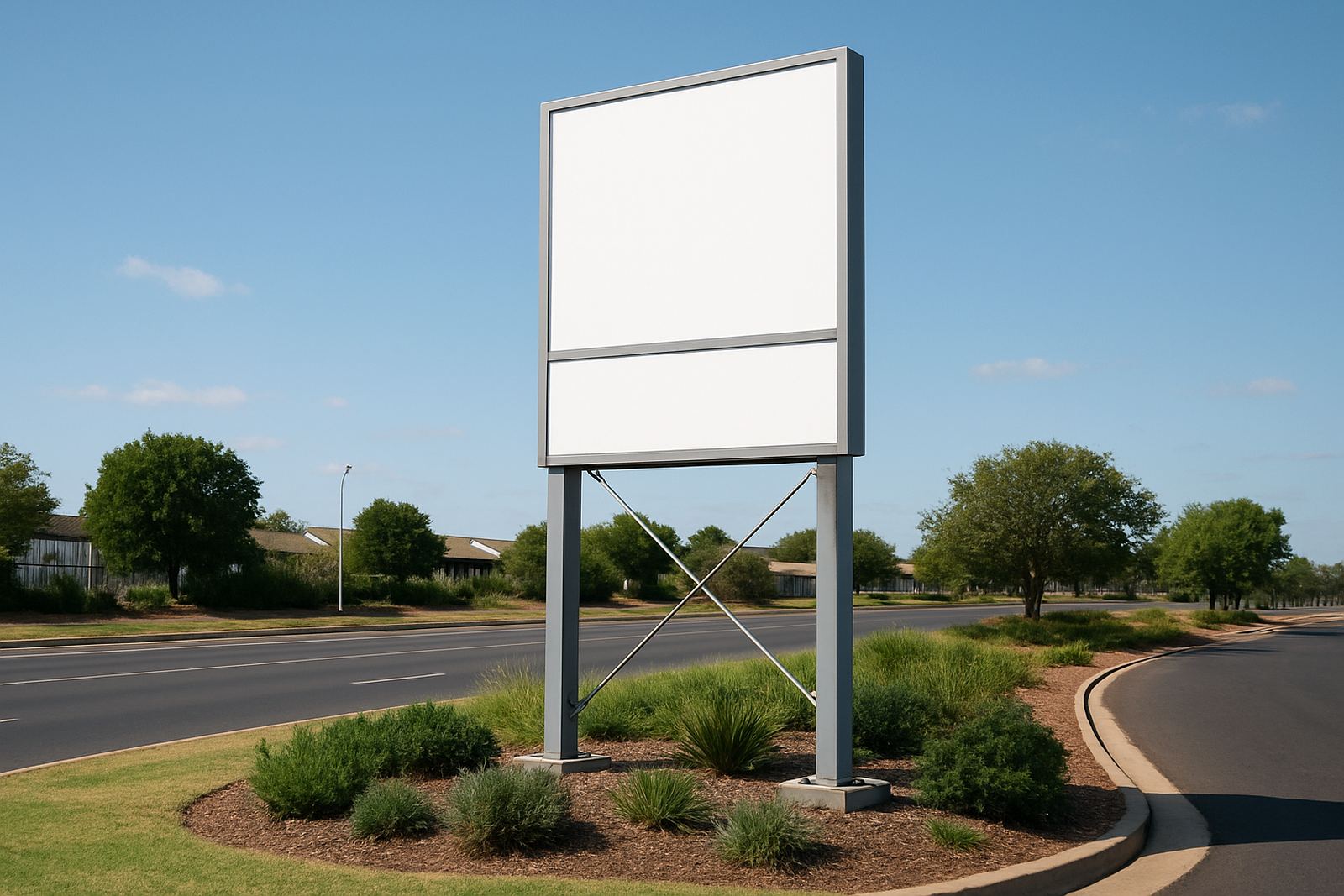
What a pylon sign does for your site
A pylon sign is a freestanding sign structure built to carry your business name, logo, tenant list or directional message above ground level. It is used where you need stronger visibility than wall signage can give, especially along busy roads, at junctions, or where the entrance sits back from the street. For centres, forecourts, office parks and industrial sites, a well placed pylon helps drivers find the entrance before they miss it.
In Bloemfontein conditions, that usually means planning for sun, dust, wind and the occasional strong summer storm. We build pylon signs to suit the site and the message, whether it is a single face sign, a double sided sign, or a taller landmark pylon for multi-tenant properties. The structure can be steel framed with aluminium cladding, painted to match your brand, and fitted with printed faces, router-cut letters, illuminated panels or tenant strips.
- Freestanding roadside visibility
- Suitable for single businesses or multi-tenant centres
- Can include directional text, tenant names or logos
- Built for outdoor use in Free State weather
Sizes, formats and finishing options
There is no single standard size for a pylon sign because the right proportions depend on traffic speed, setback from the road, and how much information must be read at a glance. Smaller site markers may be around 2 metres high, while larger entrance pylons can reach 4 to 8 metres or more, subject to municipal approval and engineering. The face width can range from a compact panel to a wide multi-panel display for shopping centres and business parks.
Options are selected to match visibility and maintenance needs. A powder-coated steel frame is a common choice for strength, while aluminium facing keeps weight down. For the display, we can use digitally printed panels, vinyl graphics, routed letters, raised letters, or modular tenant panels that can be updated without replacing the whole sign. Where night visibility matters, internal lighting or external floodlighting can be added, depending on the power available on site.
- Typical heights: 2 m, 3 m, 4 m, 6 m and custom sizes
- Single face or double sided faces
- Static branding or changeable tenant panels
- Printed panels, vinyl cut text or raised letters
- Painted, wrapped or cladded finishes
Where pylon signs work best in the Free State
Pylon signs suit properties that need clear street presence and quick identification. In Bloemfontein, Mangaung, Botshabelo, Thaba Nchu, Welkom and Kroonstad, they are commonly used at entrance roads, retail centres, medical facilities, fuel forecourts, warehousing parks and schools. They also work well on corner sites where vehicles approach from more than one direction.
They are useful where municipal planning or building lines limit wall signage, or where the building sits too far from the road for a wall panel to carry enough impact. On larger sites, a pylon can also support wayfinding, for example main entrance, deliveries, visitors, reception, parking or after-hours access. If the site is exposed to open veld wind or heavy traffic spray, we allow for heavier base work and proper anchoring. Small typo maybe it is worth noting that a sign that is too low often gets lost behind cars and hedges, so height matters.
- Retail centres and tenant complexes
- Forecourts and service yards
- Office parks and medical facilities
- Industrial entrances and logistics sites
- Schools, churches and community facilities
Installation, foundations and power requirements
Installing a pylon sign starts with a site survey so we can check access, underground services, visible distances and soil conditions. A proper foundation is essential. Most pylons need a reinforced concrete base, with anchor bolts set to the frame design. The foundation size depends on height, wind load, ground condition and whether the sign will carry lighting. On some sites, especially where there is vehicle access close by, barriers or bollards may be recommended to protect the structure.
If the sign is illuminated, power must be planned early. We check whether mains power is available at the nearest point and whether a trench or conduit is needed. Lighting may be LED modules, strip lighting or external floodlights depending on the face design. For sites with load-shedding or unreliable supply, we can discuss lighting that reduces consumption, but the sign still needs a proper electrical connection for safe operation. Gas is not normally required for standard pylon signs, although special decorative lighting effects can be discussed if the site calls for it.
- Site survey before manufacture
- Reinforced concrete footing and anchor system
- Electrical conduit for illuminated signs
- Protection against impact and wind loading
- Municipal approval may be needed before installation
Care, cleaning and routine servicing
A pylon sign should be inspected regularly, especially after strong wind, heavy rain or electrical interruptions. Dust builds up quickly in the Free State, and coastal type corrosion is not the main issue here, but sun exposure and weathering still affect print and paint over time. Cleaning should be done with mild soap and water, not harsh chemicals that can dull the face or damage vinyl edges. If the sign is illuminated, lamps, drivers and wiring should be checked for failure before the entire sign goes dark.
We recommend planned maintenance for sites with tenant changes, broken panels or fading graphics. If a business changes name or occupies a new unit, a modular pylon can often be updated without a full rebuild. Central Signs also handles refurbishment, debranding and maintenance visits so the sign keeps its finish and stays legible. A loose panel, cracked face or flickering light should be attended to quickly because it can turn into a bigger repair if ignored for too long.
- Wash with mild detergent and soft cloths
- Inspect fixings and panels after storms
- Check illumination and wiring periodically
- Replace faded prints before visibility drops
- Schedule maintenance for tenant updates or damage
What to confirm before you place an order
Before we start a pylon sign, it helps to confirm the exact message, size, site position and whether the sign is for a single business or several tenants. We also need to know how far the sign must be read from, whether it will face one road or two, and if the site has enough room for a concrete base and access during installation. For businesses in central Bloemfontein or along busier routes in Mangaung, traffic speed and approach angle make a big difference to the final layout.
It is also important to check if your landlord, body corporate or local municipality requires approval. Some sites need drawings, engineering details or size limits. When you send an enquiry through our contact page, we can help with artwork setup, logo redraws, fabrication and installation planning. That way the sign is made to fit the site properly and not just the idea on paper. If the brief is clear from the start, the job tends to move faster and the finish is neater.
- Exact wording and logo files
- Desired height, width and viewing distance
- Whether illumination is needed
- Site access, foundation space and power availability
- Approval requirements from landlord or municipality
Built for business entrances that need to be seen
Pylon signs are one of the most effective ways to mark an entrance, guide visitors and carry a name above passing traffic. They suit sites that need a professional first impression and a sign that can stand up to everyday weather and regular use. Central Signs makes pylon signs for Bloemfontein and surrounding Free State towns with practical attention to size, structure and maintainability, because a sign has to do its job long after it is installed.
Whether your site needs a simple entrance marker or a taller multi-tenant display, we can assist with the survey, fabrication and installation. The aim is a sign that reads clearly, fits the property and stays in service without causing ongoing problems. A pylon sign is not just about being seen, it is about being found.
Key facts
| Product type | Freestanding outdoor pylon sign |
|---|---|
| Typical height | 2 m to 8 m plus custom engineering |
| Construction | Steel frame with aluminium or cladded faces |
| Graphics options | Printed panels, vinyl cut text, raised letters, tenant panels |
| Lighting | Non-illuminated, LED lit, or floodlit options |
| Use areas | Centres, forecourts, offices, business parks and industrial sites |