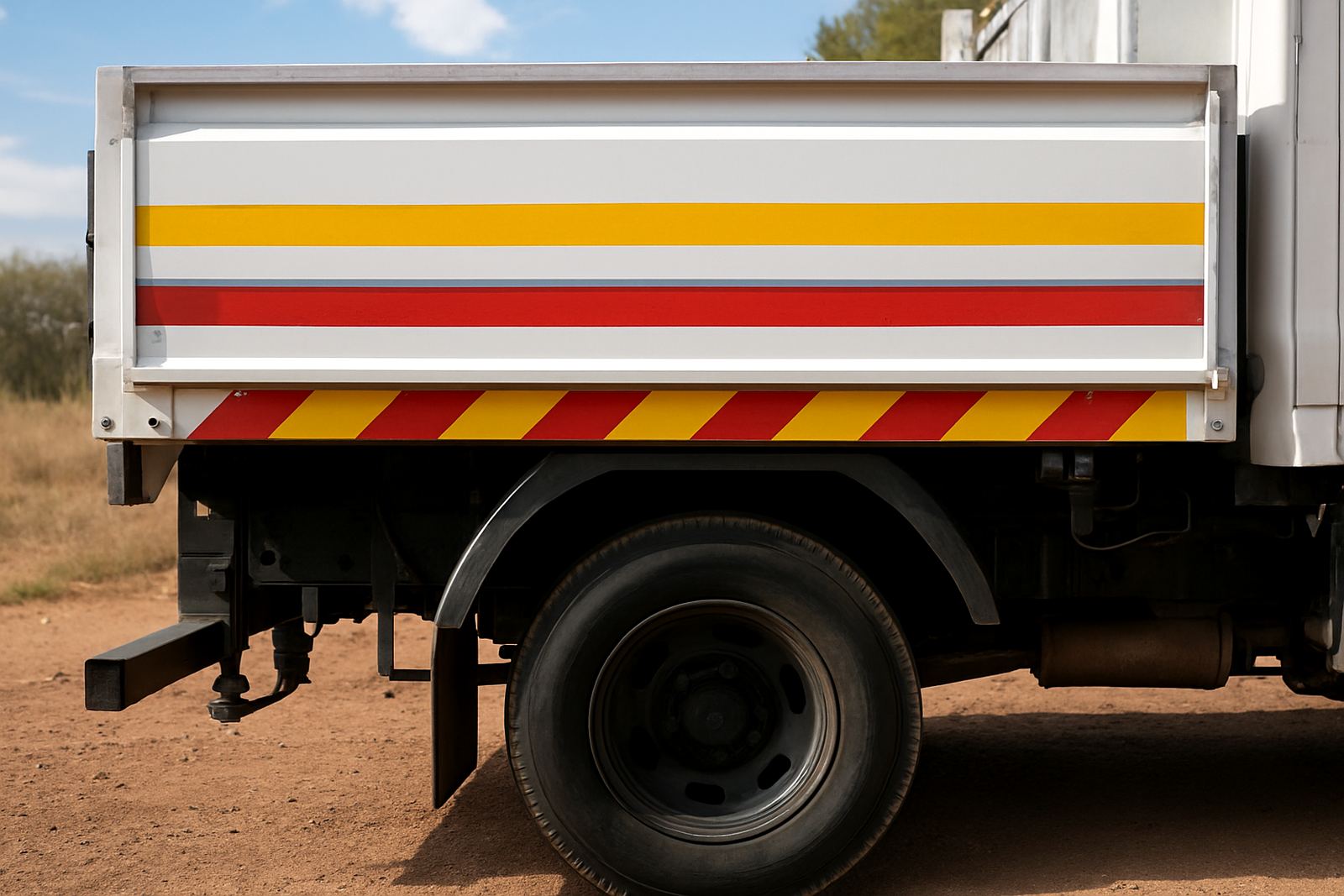
What reflective decals do on site and on the road
Reflective decals are cut or printed graphic markings made from a light-returning film that becomes visible when headlights, torch light or site lighting hits it. They are commonly used on bakkies, panel vans, trailers, delivery trucks, service vehicles, barricades, gates, poles, skip bins and safety boards. In practical terms, they help other road users and staff spot the vehicle or hazard sooner, which matters on early starts, after-hours work and winter mornings around Bloemfontein when visibility can be poor.
At Central Signs we make reflective decals for fleet identification, hazard marking, route numbering, speed notices, emergency wording and simple high-contrast graphics. The finish can be plain text, symbols, arrows, striping or full cut lettering. If you need a clean, workmanlike look that is easy to read from a distance, reflective film is usually the right choice.
These decals work well for municipal, industrial, agricultural and commercial use. They are not only for road vehicles either, they also suit sliding gates, roller shutters and warehouse doors where a visible warning or instruction helps with day-to-day safety.
Sizes, colours and reflective options that suit the job
Reflective decals are made to suit the surface and the viewing distance. Small labels may be only 30 mm high for equipment tags, while fleet numbering is often 50 mm to 150 mm high. Larger safety wording, directional arrows and side striping are usually made to suit the body panel size, with common lengths ranging from 300 mm up to several metres on a full vehicle side. If the job needs it, we can break a graphic into sections for easier handling and fitting.
Colour choice depends on legibility and the surface underneath. White, yellow, red, blue and green are common, with silver reflective film used where a neutral look is preferred. High contrast is important, especially on dark paint or powder-coated steel. For warning use, the usual pairing is red and white or yellow and black. We can also add non-reflective printed areas where a logo or icon needs to stand out in daylight.
- Cut lettering for names, numbers and short messages
- Striping for side markings, tail ends and gate edges
- Arrow and hazard symbols for loading areas and plant
- Number sets for fleet and asset identification
- Printed reflective graphics for logos and custom wording
In the Free State sun, colour fade matters. We normally suggest a reflective grade and print method that matches the exposure, whether the item sits on a shaded depot wall or on a vehicle parked outside all day in Hamilton, Mangaung or further out in Welkom.
Where reflective decals are most useful
Reflective decals suit any site where moving vehicles, staff or visitors need to see markings quickly. Fleet operators use them for bakkies, panel vans, minibuses, construction vehicles, service trucks and trailers. Farms and agri businesses use them on equipment, tanks, gates and sprayers. Warehouses and factories use them on dock doors, barriers, guard rails and access routes.
They are also useful for compliance and identification. If you need a number plate style marking, a contractor ID, a no entry notice or a clearly visible emergency label, reflective film gives a sharper read at night than ordinary vinyl. It is a practical choice for loading bays, driveway exits and roadside work where dust, drizzle and early dusk can make ordinary graphics hard to see.
- Fleet and service vehicles that travel at night
- Trailers, plant and agricultural machines
- Gates, poles, barriers and perimeter points
- Safety boards, warning strips and access notices
- School, church, retail and municipal vehicles
Because our work covers Bloemfontein, Mangaung, Botshabelo, Thaba Nchu, Welkom and Kroonstad, we often see a mix of urban and highway use. That means the decal needs to handle wind, dust, washdowns and regular driving without curling or losing grip.
Installation on vehicles, walls and equipment
Installation starts with a clean, dry surface. For vehicles we remove dust, polish residue and road film before fitting. For walls, doors and metal panels we check for chalking, loose paint, oil and rust spots. Reflective decals bond best to smooth painted metal, sealed powder coat, glass and properly prepared composite panels. If a surface is rough, porous or badly cracked, we will advise on a better mounting method.
Most reflective decals are self-adhesive, so no power or gas is needed for the decal itself. Some larger jobs do require heat tools and measuring equipment during installation, particularly on curved panels, mirrors, canopies or ribbed bodywork. For bigger fleet markings, we may work on site with enough space for alignment, or install at our Hamilton base if the vehicle can be dropped off.
Load-shedding does not stop us from fitting, but it can affect some production steps if lighting or finishing equipment is needed. Where possible we schedule the job around the available work window and keep the process simple so your vehicle is not off the road longer than necessary.
Care, washing and when a refresh is due
Reflective decals need basic care to stay readable. Regular washing with clean water and mild soap is enough for most applications. Avoid harsh solvents, heavy scouring pads and pressure washer nozzles held too close to the edge of the graphic. On work vehicles, diesel mist, cement dust and coastal grime can shorten the clean look if they are left to build up, so a quick wash every week or two helps.
In Bloemfontein the main issue is dust and sun exposure, while coastal humidity is not usually the problem inland. Still, vehicles that travel to other regions or stand outside for long periods can see edge lift, dulling or surface scratching over time. If the film becomes brittle, the adhesive lifts, or the reflective finish no longer reads clearly at night, it is time to replace or refurbish the marking.
We also do maintenance visits and sign refurbishment where a fleet has mixed old and new markings. If only one panel is damaged, we can often replace that section without redoing the whole vehicle. That saves time and keeps the branding consistent.
What to check when ordering reflective decals
To get the right result, it helps to check a few details before we cut the job. Measure the available area carefully, including curves, handles, seams and rivets. Decide whether the decal must be seen in daylight only, or day and night. If the graphic must match an existing fleet, bring a clear reference photo or the original artwork if you have it.
We can assist with artwork setup, logo redraws and vinyl cutting where needed. If the design is already final, we still need the correct sizes, mounting surface and colour preference before production starts. For fleet work, it helps to know how many vehicles are involved and whether they must all match exactly. A small typo on a number or word is easy to miss on paper, but it shows up immediately once the decal is on the vehicle so the proofing step matters.
- Exact size of the panel or surface
- Indoor, outdoor or vehicle use
- Day visibility only or night reflectivity required
- Colour choice and whether the base colour affects legibility
- Quantity, fitment location and deadline
- Any existing branding, numbering or compliance wording
For businesses across Bloemfontein, Mangaung, Botshabelo, Thaba Nchu, Welkom and Kroonstad, reflective decals are a simple way to improve visibility without overcomplicating the job. If you need fleet markings, safety labelling or night-time identification, this is a practical option that does the job well.
Key facts
| Material | Reflective self-adhesive vinyl film for indoor and outdoor use |
|---|---|
| Typical sizes | From 30 mm labels to multi-metre vehicle striping and panel graphics |
| Common colours | White, yellow, red, blue, green and silver reflective |
| Use cases | Fleet marking, safety signage, hazard warnings, numbering and directional graphics |
| Installation surface | Painted metal, sealed powder coat, glass, composite panels and prepared doors |
| Service life | Depends on exposure and care, with regular washdown and inspection recommended |