
Brief From an Industrial Depot in Hamilton
The client was a service fleet based in Hamilton, Bloemfontein, with vehicles travelling between Mangaung, Botshabelo, Thaba Nchu and nearby service points. The team needed their vehicles to be easy to identify at a glance, especially when parked outside client premises, moving through loading areas, or arriving after dark. The brief was straightforward, but there were a few site realities to work around: trucks came and went on tight schedules, the depot yard was exposed to dust, and the fleet could not afford long downtime.
They asked for a full graphics package that would carry the same visual system across bakkies and light commercial vehicles. The finish had to look tidy on white paintwork and also hold up on the darker panels where contrast can disappear if the artwork is too busy. We also had to allow for unit numbers, small safety markings, and removable application on serviced panels. As is often the case with fleet work, one missed vehicle can throw the whole schedule off, so the sequence had to be planned carefully.
- Client type: industrial service fleet operating from Bloemfontein
- Vehicle mix: bakkies, panel vans and light service units
- Operating area: Bloemfontein, Mangaung, Botshabelo and Thaba Nchu
- Main need: clear identification, durable finish, quick turn-around
What We Supplied and How the Artwork Was Set Out
We handled artwork setup, logo redraws, print production, vinyl cutting and vehicle application in-house. The graphics were built as a consistent system rather than one-off stickers on each vehicle, so the same layout could be scaled for different body sizes. That made it easier to keep the fleet looking uniform while still allowing for registration numbers, contact panels and asset identifiers. The final artwork included door logos, side strips, rear identification, warning panels and small reflective sections where needed.
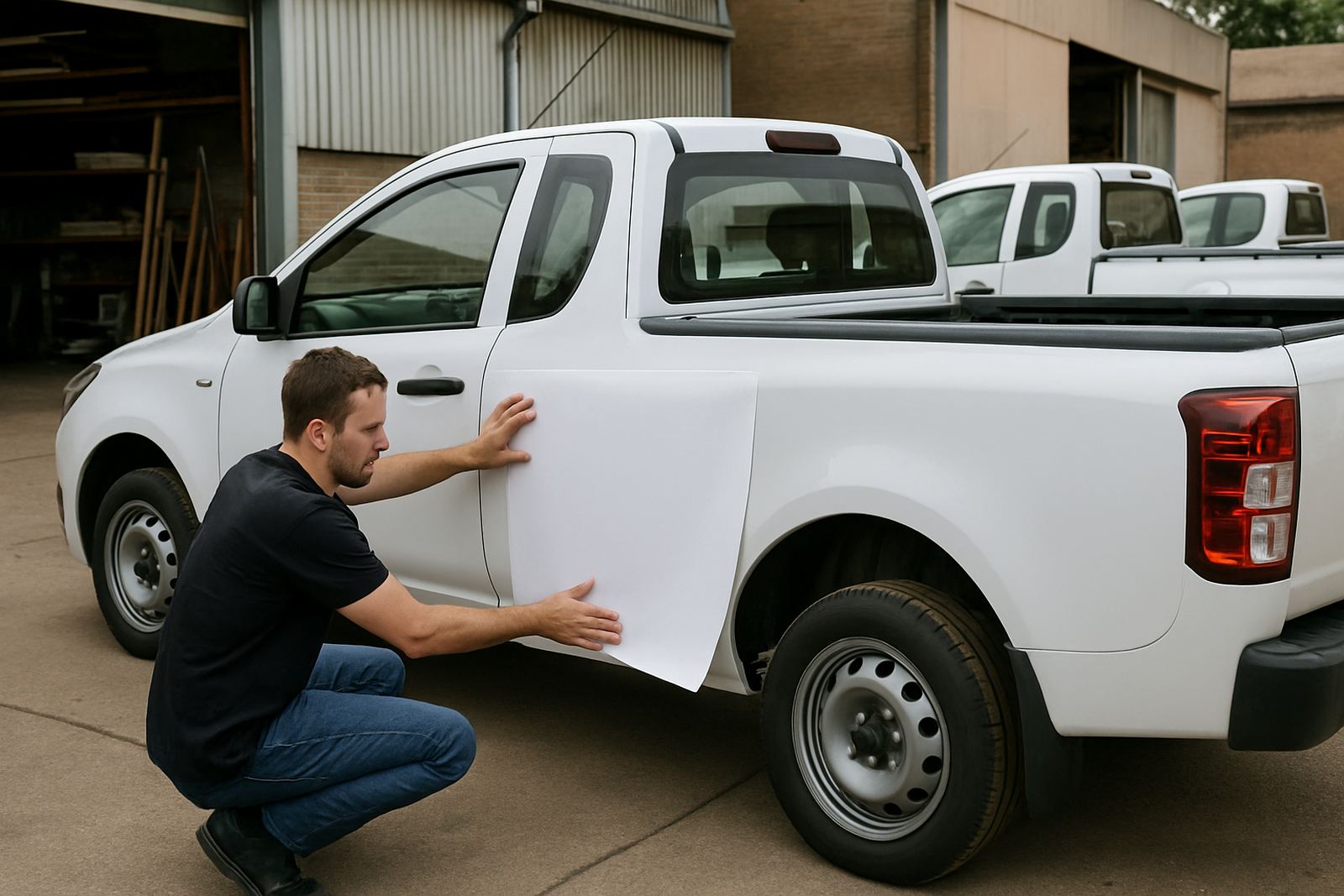
The main colours were matched to the existing branding and prepared for print on durable cast and polymeric vinyls, with laminate where areas would get regular handling. We used a high-contrast layout so that the wording remained readable from a distance of around 20 to 30 metres, which matters in service yards and at roadside stops. A few of the vehicles had curved body panels and recessed sections, so the cut lines had to be adjusted carefully. Johan handled the physical application on the larger units, while Kagiso focused on the vehicle graphics details and alignment. Zanele prepared the production files and cleaned up the logo artwork where the supplied files were too low-resolution for clean output.
- Vinyl cutting for text and identification marks
- Printed graphics for larger side panels and rear doors
- Graphic lamination for abrasion resistance
- Reflective accents for low-light visibility
Working Around Downtime, Weather and Yard Conditions
The depot could only release vehicles in short windows, so the installation was split into stages over two weeks. That let the fleet keep moving while we worked through the units in a sensible order. We started with the vehicles that could be taken out of service first, then moved onto the higher-use units once the first batch was back in circulation. The full package took three weeks from final artwork approval to the last vehicle leaving the bay, including sign-off on test prints and a brief check on colour consistency.
Bloemfontein’s dry air is kind to application in some ways, but dust can get onto panels very quickly if a vehicle sits outside too long. We planned the installation windows for early mornings and late afternoons where possible, and we avoided panels that had not been properly washed and degreased. On one of the vans the side panel had a slight lip near the rear wheel arch, so we had to work the film in carefully to avoid lifting. That kind of detail is where experience saves time later. If the prep is rushed, the edge starts lifting sooner than it should, and then you are back onsite before you want to be.
- Timeline: 3 weeks total
- Installation stages: 2 weeks across multiple vehicle visits
- Constraints: dust, limited downtime, mixed body shapes, service-yard movement
- Prep method: wash, degrease, dry fit, then application
Results on the Road and at the Depot
Once the fleet was finished, the vehicles looked like they belonged together. The branded panels were easy to read at the gate, in traffic and on client sites, and the rear markings gave the vehicles better visibility when parked with doors open. The client wanted something practical rather than flashy, and the final result gave them a neat working fleet that still carried enough presence to be noticed. The reflective details helped after dark and during early winter starts, when service crews are moving around in low light.
It also made the fleet easier to manage internally. Unit numbers were placed consistently, so the depot team could identify vehicles quickly for dispatch and maintenance. That might sound small, but on a busy morning it saves time. The finish has held well under regular washing and normal road grime, and the laminated sections are still cleaning off cleanly with no lifting along the edges. For an industrial fleet, that matters more than a fancy design ever will.
Why This Package Worked for a Free State Service Fleet
The success of the job came down to matching the graphics to the way the vehicles are actually used. These are not display units. They spend time on gravel approaches, on municipal roads, and in yards where the vehicles are parked close together. So the layout had to be simple, durable and easy to maintain. We kept the number of colours under control, used clean line work, and made sure the artwork would still make sense when a panel was partly hidden by a door handle, canopy or loading gear.
For businesses in Bloemfontein and the wider Mangaung area, fleet graphics also have a compliance side. If you are working near public areas or on municipal contracts, clear vehicle identification can help with site access and client confidence. We have seen too many fleets lose impact because the graphics are either overcomplicated or fitted with poor alignment. In this case, the client got a consistent result across the whole run, and the vehicles looked presentable from day one.
- Simple layout for daily use and quick recognition
- Durable finish suited to washdowns and road dust
- Consistent numbering across the fleet
- Better visibility for after-hours work
What We Would Repeat on the Next Fleet Rollout
If we were doing the same project again, we would keep the same production approach and the same fitment sequence. We would still start with a full site survey, confirm vehicle measurements on the day, and test the first print set before running the full batch. That avoids surprises with panel sizes, trim lines or a last-minute vehicle swap. We would also keep the reflective elements, because they add useful visibility without making the vehicles look overdone.
For depots in Hamilton, Bloemfontein and surrounding areas, this is the kind of work that benefits from clear planning and steady installation rather than rushing. The right result is not about overcomplicating the graphics. It is about making sure the branding works on the road, in the yard and in poor weather, and that it still looks right after months of use. That is exactly what this package was built to do.
Key facts
| Project type | Fleet graphics package for service vehicles |
|---|---|
| Location | Hamilton, Bloemfontein |
| Operating area | Mangaung, Botshabelo, Thaba Nchu and nearby Free State routes |
| Timeline | 3 weeks from approval to final application |
| Materials | Printed vinyl, cut vinyl and graphic lamination |
| Finish | High-visibility branding with reflective accents |