
What an office directory sign does
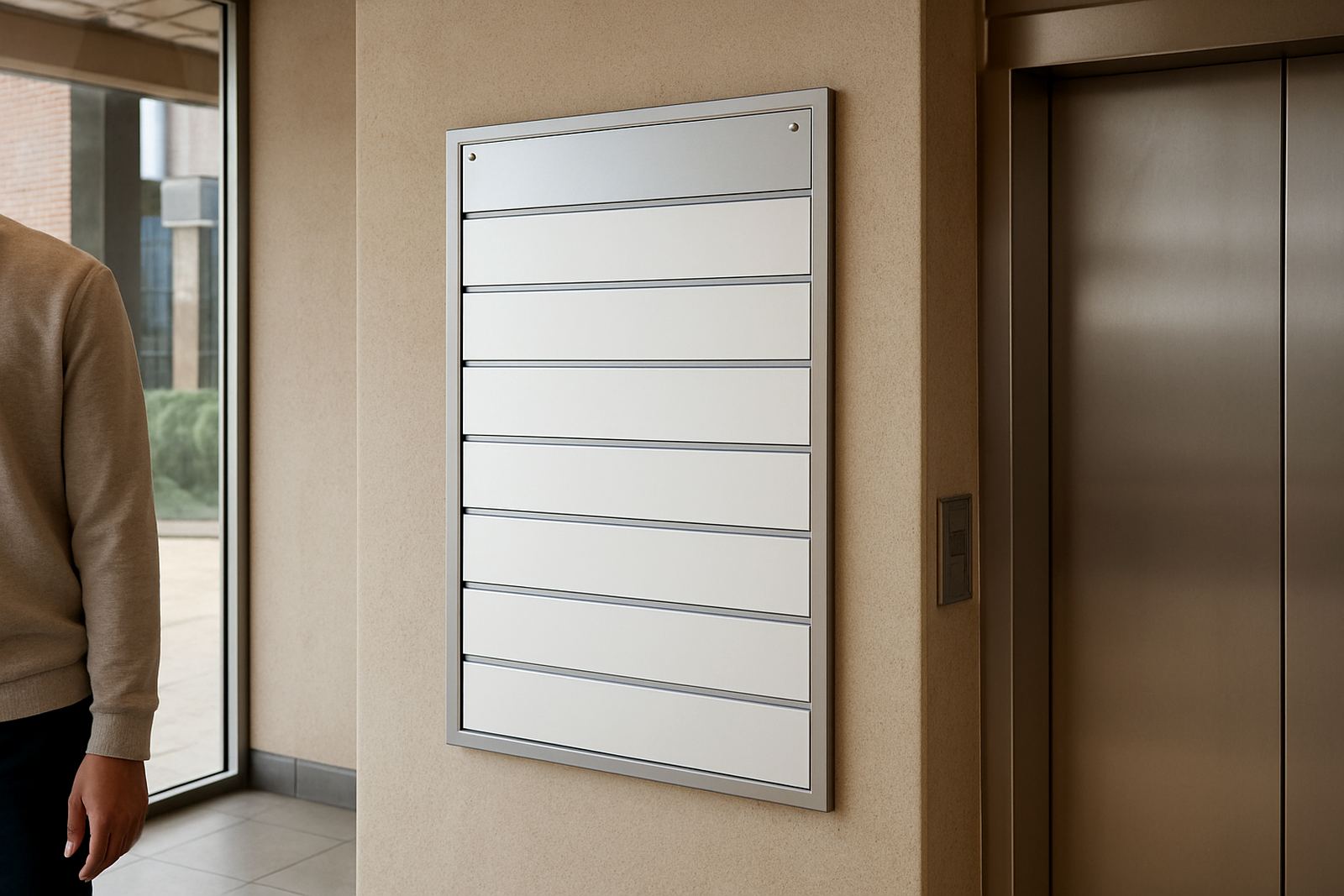
An office directory is the sign that tells people where to go once they are inside a building. It can list tenants on a single panel, show room numbers by floor, or guide visitors from the foyer to reception, meeting rooms, clinics, training spaces and admin offices. In a multi-tenant block it reduces confusion, and in a larger campus it keeps visitors moving with less interruption to staff.
We make directories for wall mounting, stand-off mounting and freestanding use, depending on the space available and the amount of detail that needs to be shown. For professional buildings in Bloemfontein, Mangaung and the surrounding towns, a directory is often the first sign people stop at after parking or entering through security. It must be readable at a glance, not overfilled, and finished so it still looks tidy after daily use.
- Tenant and suite listings
- Floor and room identification
- Reception and visitor guidance
- Campus, clinic and office block wayfinding
Sizes, formats and material options
Office directories are usually made to suit the amount of copy, the mounting position and the viewing distance. Smaller internal directories can start at about 300 x 400 mm, while larger lobby boards may run to 600 x 900 mm or more. For buildings with changing tenants, we often make a modular layout so names can be updated without replacing the whole sign. This is practical for sectional title offices, medical suites and business parks where tenants move around from time to time.
Common material choices include aluminium composite, acrylic, brushed effect panels, PVC, rigid board and laminated printed vinyl on a prepared base. Lettering can be cut vinyl, digitally printed, or a mix of the two if there are logos, arrows and room lists to combine. If the directory is going into a sunlit foyer or near a window, we use finishes that resist fading and warping. In coastal areas the same principle applies, because moisture can get into poorly sealed edges quicker than people expect.
- Standard sizes from 300 x 400 mm up to 1200 x 1800 mm
- Portrait or landscape layout
- Single panel or modular insert system
- Indoor matte finish or low-glare gloss finish
Where directories work best
These signs suit any building where visitors need guidance and staff do not have time to explain directions all day. Typical placements include main entrances, lifts, stair landings, reception walls, corridor junctions and outside boardroom areas. They are also useful in churches, schools, private practices, municipal offices, shared workspaces and training centres where different people use the same building but do not know it well.
For campuses in Botshabelo, Thaba Nchu, Welkom and Kroonstad, a directory can be part of a broader wayfinding set that includes building numbers, parking bay markers, wall plaques and door labels. Where there are access controls, the directory should be visible before the visitor reaches the gate intercom or security point. That saves time and cuts down on back-and-forth questions at busy times.
- Entrance foyers and lift lobbies
- Shared office buildings and business parks
- Schools, colleges and training facilities
- Medical rooms, clinics and admin centres
Installation, mounting and power needs
Most office directories do not need power or gas. They are non-powered signs unless you ask for illuminated edging, backlighting or an electronic insert area. A standard directory is fixed to a wall with concealed hardware, stand-off fittings or a frame system, depending on the wall surface and the weight of the sign. We check the substrate before installation because painted gypsum, concrete, brick and cladding all need different fixing methods.
If the directory is large or includes an illuminated section, we plan the cable route and isolate the electrical connection so it can be serviced safely. Any powered directory should have access for maintenance and a clear point of switching. In buildings with load-shedding, it is worth deciding early whether the sign must remain readable without power, or if a battery backup point is needed for the wider reception area. Our installers work around business hours where possible, so access to tenants and public areas stays manageable.
- Wall, flush or stand-off mounting
- Freestanding frame options for entrances
- Power only needed for lit or electronic elements
- Access planning for maintenance and future updates
Care, updates and servicing
Directory signs should stay clean and current, otherwise they stop helping people. A matte surface can be wiped with a soft cloth and mild cleaner, while glossy acrylic needs a little more care to avoid scratches. Harsh solvents are not recommended because they can haze the face or lift printed finishes. In dusty areas and near busy entrances, a quick monthly clean is usually enough. Coastal humidity can also leave a film on exposed signs, so regular wiping helps them stay legible.
Where tenants change, we can update names, suite numbers and arrows without replacing the complete board if the layout was designed for it. That is one reason to think ahead when ordering. A directory with a fixed full print may look neat on day one, but it is harder to alter later. For buildings with frequent leasing changes, a modular system saves time and keeps the lobby looking organised.
- Wipe with a soft cloth and mild soap solution
- Avoid thinners and abrasive pads
- Keep tenant names and room numbers current
- Check fasteners after renovations or cleaning work
What to check before you order
The best office directories start with accurate information. Before production, confirm the final tenant list, spelling, room numbers, arrows, floor levels and any logos that must appear. It also helps to decide whether the sign must be easy to update later or whether it is a fixed permanent board. If the building has multiple entrances, tell us which one most visitors use so the layout can be planned for that route first.
We also need to know the viewing distance, the wall size available, and whether the sign will sit in direct sun. If your building in Hamilton, Bloemfontein or elsewhere in Mangaung has glass walls, polished stone or dark paint nearby, the contrast needs to be strong enough to read quickly. A directory should be practical first and pretty second, though of course it should still look smart in a professional space.
- Final list of names, departments and room numbers
- Preferred size and mounting position
- Indoor or sheltered outdoor use
- Need for future updates or tenant changes
Key facts
| Product type | Multi-tenant and internal office directory signs |
|---|---|
| Common sizes | 300 x 400 mm to 1200 x 1800 mm, custom sizes available |
| Materials | Aluminium composite, acrylic, PVC, rigid board and laminated print |
| Finish options | Matte, satin, gloss, brushed effect, stand-off mounted |
| Installation | Wall mounted, flush mounted or freestanding |
| Power needs | None for standard directories, power only for illuminated or electronic versions |